Peptide Therapy Cost: CJC-1295, BPC-157 & the Legal Gray Zone (2026)
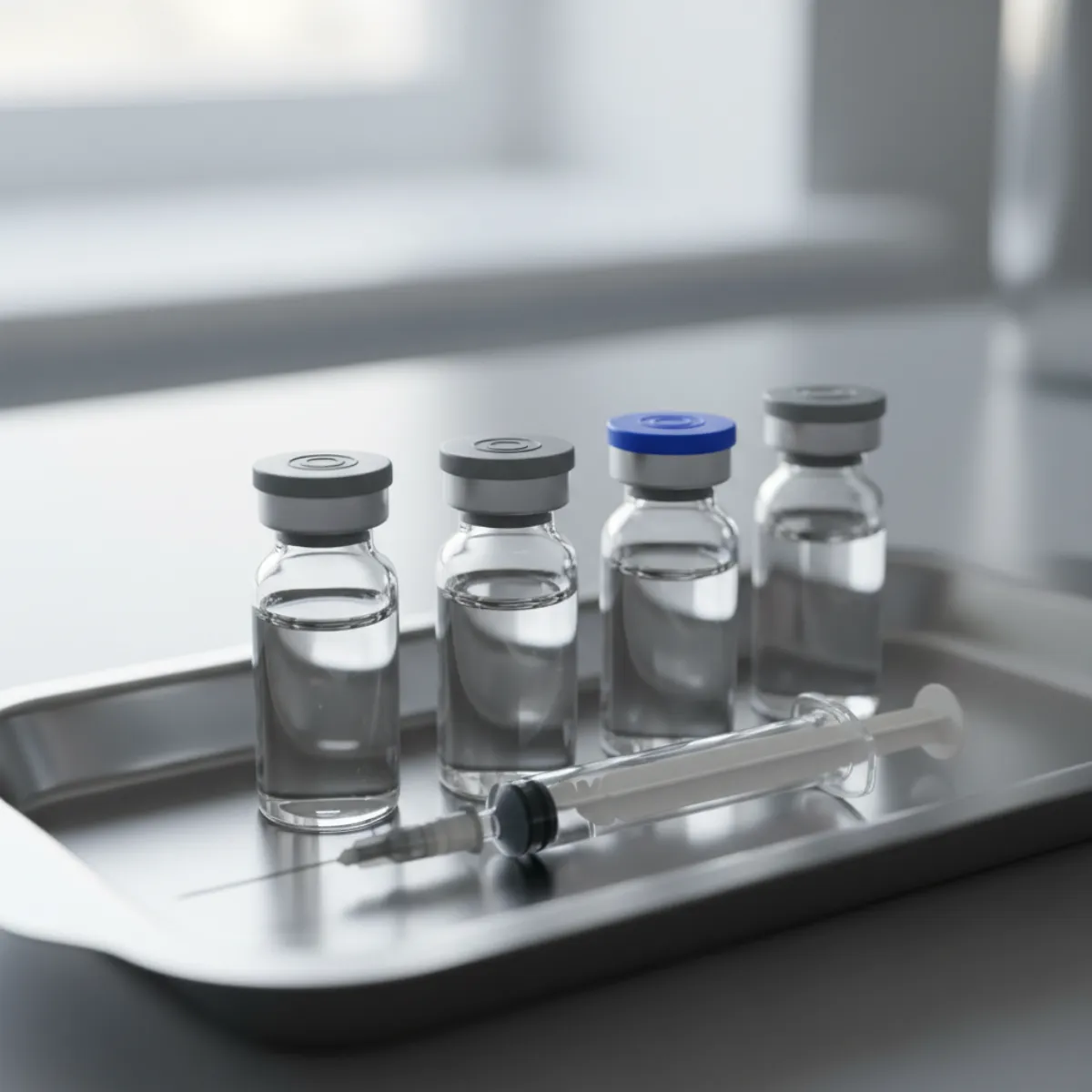
The typical peptide therapy cost starts at $399 per month for a compounded CJC-1295 and Ipamorelin blend on a subscription plan. A single month without a subscription runs $499. No peptide is FDA-approved for anti-aging. Prices for experimental peptides like BPC-157 are not transparently published and vary wildly.
Disclaimer: This information is for educational purposes only and does not constitute medical or financial advice. Peptide prices change frequently. You should verify all costs directly with the provider and consult a licensed clinician before starting any experimental or compounded therapy. We sell nothing and have no financial relationship with the clinics mentioned.
How much does peptide therapy cost?
The exact price of your treatment depends entirely on the specific compounds, the clinic model, and the duration of your financial commitment. For the most common anti-aging stack, CJC-1295 mixed with Ipamorelin, patients pay between $399 and $499 for a one-month supply through a concierge or telehealth provider. Insurance does not cover these treatments. You will pay the entire bill out of pocket.
We use Concierge MD in Los Angeles as our verified baseline for current market pricing. Their model represents the standard premium telehealth structure. They offer three distinct pricing tiers based on how much medication you buy and whether you agree to recurring billing.
| Treatment Plan (CJC-1295 / Ipamorelin) | Price |
|---|---|
| Subscription Plan (3-month minimum commitment) | $399 / month |
| Single 1-Month Supply (No subscription) | $499 |
| 3-Month Supply (Purchased upfront) | $1,299 |
How much is CJC 1295 Ipamorelin cost over time?
Looking at a single month of treatment gives you an incomplete picture of the actual financial burden. Peptides are not one-time treatments. Clinics market them as long-term protocols for metabolic optimization and recovery. If you commit to a year of therapy, the math changes significantly.
If you purchase a single one-month supply every time you run out, you will spend $499 per month. Over twelve months, this equals $5,988. If you buy the three-month supply upfront for $1,299, your average monthly cost drops to $433. Over a full year, the bulk purchase strategy costs $5,196. Buying in bulk saves you $792 annually compared to the single-month retail rate.
You must also factor in the cost of supplies. Most clinics include insulin syringes and alcohol swabs in the initial purchase price, but you should always verify this before paying. If a clinic requires you to buy your own bacteriostatic water and sterile injection supplies, expect to add another $30 to $50 to your initial startup costs.
Before you start, we recommend using our Longevity Cost Estimator to see how an extra $400 to $500 per month impacts your overall health budget. Recurring out-of-pocket injectables quickly become the most expensive line item for anyone interested in life extension.
Why do peptide subscription discounts only apply to month one?
Many telehealth platforms advertise a $399 per month subscription rate to acquire new patients. This looks highly attractive compared to the $499 retail price. However, this is a standard loss-leader marketing strategy. The clinic takes a smaller profit margin on your first order to lock you into a recurring billing cycle.
The $399 subscription discount often applies to the first month only. Clinics typically require a three-month minimum commitment to activate this tier. If the price jumps back to the standard rate for months two and three, your effective recurring price will exceed $399 per month. For example, paying $399 for month one, and $499 for months two and three, brings your 90-day total to $1,397. In this scenario, the subscription is actually more expensive than simply buying the $1,299 three-month supply upfront.
You must read the fine print of any medical subscription agreement. Ask the provider for a highly specific, written breakdown of the exact charges that will hit your credit card on days 30, 60, and 90.
What is the true BPC 157 cost?
You will not find a reliable, transparent price for BPC-157 from legitimate medical providers. The retail pricing is not transparently published. We refuse to state a specific dollar figure for this compound because the market is currently fractured, unregulated, and opaque.
BPC-157 is not an FDA-approved drug, and it is not on the FDA's list of bulk substances that pharmacies may compound with. The FDA lists safety concerns for compounding it: possible immune reactions, peptide impurities, and little or no safety data for the proposed routes of administration. In its briefing for the July 2026 Pharmacy Compounding Advisory Committee, FDA staff proposed not adding BPC-157 to that list. The committee only advises, and until the FDA acts, BPC-157 stays outside normal prescription channels, in a legal gray zone.
The market has shifted entirely to "research chemical" suppliers. These vendors sell unverified vials directly to consumers under the guise of "research use only." These websites hide actual consumer prices behind bulk tiers, VIP memberships, or cryptocurrency payment discounts. The prices on these sites do not reflect a legitimate medical product. They do not include the cost of a doctor's consultation, sterile testing, or legal protection.
Treat BPC-157 as entirely experimental. If a wellness clinic claims to offer it, you must ask them directly where they source it, given that it is not on the FDA's compounding list. Do not trust a fabricated retail average found on a biohacking forum. You have no guarantee of the vial's contents, purity, or safety.
What about the cost of Epitalon?
Epitalon is another highly sought-after longevity peptide. Like BPC-157, its retail pricing is not transparently or reliably published. Epitalon is not approved for human use in the United States, and standard compounding pharmacies rarely stock it.
Buyers typically source Epitalon from overseas laboratories or domestic research suppliers. These transactions carry massive financial and biological risks. A vendor might charge $40 for a vial, or they might charge $400. Without independent, third-party high-performance liquid chromatography (HPLC) testing, you have no way to verify that the white powder in the vial is actually Epitalon.
We do not publish estimated prices for Epitalon because the market lacks standardized, legal pricing. Paying for unregulated research chemicals means you are trading financial certainty for severe safety risks.
Are these anti-aging peptides FDA-approved?
There is no FDA-approved peptide for anti-aging. Longevity peptides sold by wellness clinics are either approved drugs used off-label or compounded products with no FDA-approved version at all; CJC-1295 and ipamorelin are in the second group. The FDA evaluates and approves drugs for treating specific, diagnosed diseases. They do not approve medications for slowing the aging process, optimizing general health, or improving gym recovery.
When you buy CJC-1295 and Ipamorelin, you are buying compounded medications. They are not mass-manufactured prescription drugs sitting on the shelf at a local Walgreens. A specialized compounding pharmacy mixes the raw peptide powders into a sterile injectable solution based on a specific doctor's order.
That compounding sits on weak footing. Neither substance is on the FDA's list of bulk ingredients pharmacies may compound with, the FDA lists safety risks for both, including serious adverse events reported with each, and its Pharmacy Compounding Advisory Committee voted against adding ipamorelin and CJC-1295 to that list in late 2024.
This unapproved status is exactly why your insurance company will reject the claim. Much like the rapamycin cost, you are paying a premium out of pocket for an experimental use case. You bear 100 percent of the financial burden.
What drives the high peptide therapy price?
When you hand over $499 for a tiny vial of liquid, you are paying for a complex, specialized supply chain. Four distinct factors determine your final bill.
First, the raw active pharmaceutical ingredient (API) is expensive to synthesize. Peptides are short chains of amino acids. Linking these amino acids in the exact correct sequence requires specialized laboratory equipment and expensive chemical reagents.
Second, the compounding pharmacy fees drive up the baseline cost. Sterile compounding is a high-overhead business. Pharmacies must maintain strict cleanrooms, utilize specialized ventilation, and run expensive batch testing to ensure the vials contain no bacteria, endotoxins, or heavy metals.
Third, the clinic markup accounts for the largest portion of the retail price. Concierge clinics and telehealth platforms add a heavy margin to the wholesale pharmacy cost. This markup covers the medical consultation, the prescribing doctor's time, the clinic's software infrastructure, and their marketing budget.
Fourth, the delivery mechanism matters. Injectable peptides cost more to package and ship than oral medications. They require sterile glass vials, rubber stoppers, and cold-chain shipping. Many reconstituted peptides must remain refrigerated during transit to prevent the amino acid chains from degrading.
This multi-layered pricing structure is nearly identical to the NAD IV therapy cost. The raw ingredient itself is only a fraction of the total bill. The medical administration, sterile preparation, and clinic overhead drive the final price into the hundreds of dollars.
Is the financial investment worth it?
Are these injections worth a $5,000 annual commitment? We strongly recommend reading our analysis on whether longevity treatments are worth it to understand the massive gap between clinical evidence and clinic marketing.
The clinical data on CJC-1295 and Ipamorelin for human life extension is sparse. These peptides work by stimulating the pituitary gland to release endogenous growth hormone. While some patients report better sleep, faster recovery from exercise, and improved body composition, these are highly subjective benefits.
You are paying a massive premium for an experimental therapy with zero long-term human safety data for anti-aging. You must weigh the concrete, guaranteed financial cost against purely theoretical biological benefits. For many optimizers, the money spent on peptides would yield a higher return on investment if reallocated toward premium food, advanced sleep tracking, or a personal trainer.
The hidden costs of blood work and monitoring
The $499 price tag for the medication is rarely your only expense. Responsible clinics require baseline and ongoing blood work to monitor your body's response to the peptides. When taking growth hormone secretagogues like CJC-1295, doctors typically monitor your IGF-1 (Insulin-like Growth Factor 1) levels.
Some concierge clinics include this blood work in their subscription fee, but many do not. If you have to pay for an out-of-pocket longevity panel through a service like Quest Diagnostics or Labcorp, expect to spend an additional $150 to $300 every three to six months. If your IGF-1 levels spike too high, the doctor may require you to lower your dose or stop the medication entirely, meaning you have paid for a subscription you can no longer use.
The honest bottom line
Expect to pay at least $400 to $500 per month for a compounded CJC-1295 and Ipamorelin prescription from a physician-led provider. You can reduce this cost slightly by purchasing a three-month supply upfront for $1,299, but you must watch out for subscription traps where the discount vanishes after month one. Avoid the temptation to hunt for cheap BPC-157 or Epitalon on research chemical websites: nobody checks what those vials contain, and the FDA already flags safety concerns with these peptides even when a pharmacy compounds them. If you go ahead, do it under a physician with lab monitoring, knowing that none of these peptides is FDA-approved. Otherwise, keep your money in your bank account.
Sources
- Concierge MD
- FDA: bulk drug substances for compounding that may present significant safety risks
- FDA Pharmacy Compounding Advisory Committee minutes, Oct 29, 2024 (ipamorelin)
- FDA Pharmacy Compounding Advisory Committee minutes, Dec 4, 2024 (CJC-1295)
- FDA briefing document on BPC-157, July 2026 advisory committee
Frequently asked
How much does peptide therapy cost per month?
How much is CJC-1295/Ipamorelin?
Is BPC-157 legal to buy?
Are peptides FDA-approved?
Why do peptide subscription discounts only apply to month one?
Build your own honest total
Add up exactly what you're considering, with real sourced prices and the advertised-vs-effective gap.